
In short
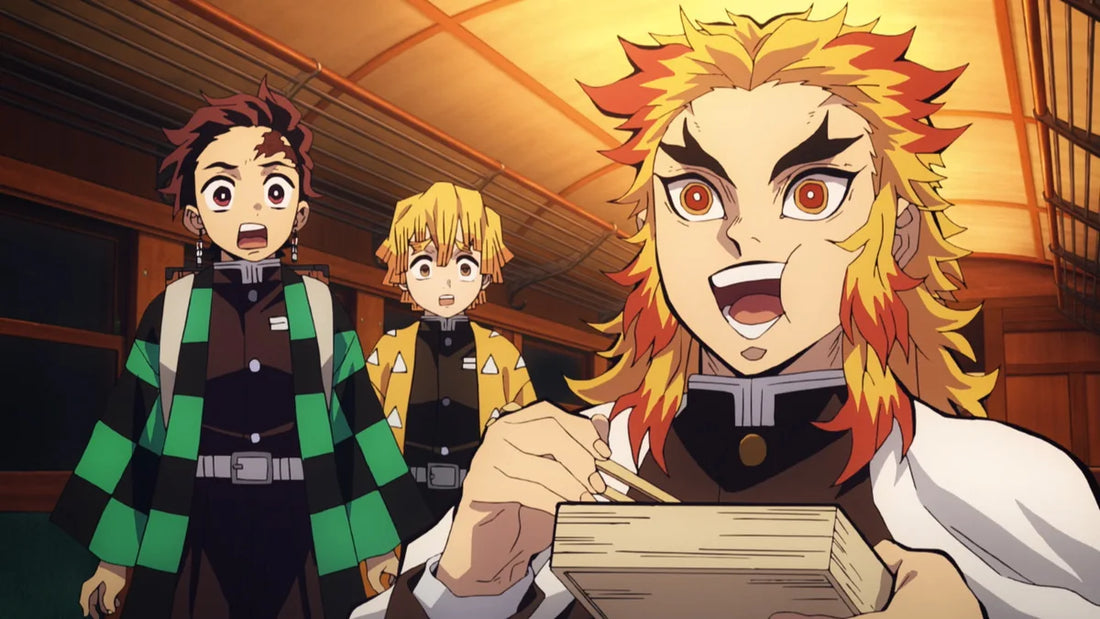
Rengoku shouts “umai” because it is his way of saying something is delicious, and he says everything at the top of his voice. “Umai” is a casual Japanese word meaning “it’s good”. Kyojuro Rengoku calls it out with every bite of his bentos on the Mugen Train, as Tanjiro and Zenitsu look on. The scene says everything about the character: a man who lives every moment to the full, sincerely, down to the simplest of meals.
Contents

In Demon Slayer, Kyojuro Rengoku’s entrance on the Mugen Train has become famous. Sitting alone in a carriage, the Flame Hashira eats one boxed meal after another, and with every bite he exclaims “umai” in a voice that makes the whole carriage jump.
The scene raises a smile, but it is not there by chance. This article explains what “umai” means, why Rengoku shouts it so loud, what this habit reveals about him, and what it becomes after his last fight. Our page on the Hashira of Demon Slayer places him among the nine Hashira.
What “umai” means
| Word | Meaning |
|---|---|
| Umai | delicious, it’s good, in a casual register |
| Oishii | delicious, in an everyday register |
| Rengoku’s tone | shouted with every bite, without restraint |
| The scene | bentos on the Mugen Train |
| His favourite dish | sweet potato miso soup |
In Japanese, there are two common ways of saying a dish is good. “Oishii” is the neutral word everyone uses. “Umai” is more direct, more casual, and more often used by men. It is a cry from the heart more than a polite compliment.
The word is also used to say someone is good at something. But in Rengoku’s mouth, in the middle of a meal, it has only one meaning: it is delicious, and he wants everyone to know. Our article on the Japanese vocabulary of Demon Slayer brings together the series’ other words.
Demon Slayer fans have taken it up as it is. Many keep the Japanese word to hail a good meal, imitating the Hashira’s booming tone.
A word turned cult
There is nothing rare about “umai” in Japanese. It is the way Rengoku shouts it that has made it one of the most imitated lines in the series.
The bento scene
At the start of the Mugen Train arc, Tanjiro, Zenitsu and Inosuke board the train to find the Flame Hashira. They spot him easily: all they have to do is follow the “umai” echoing through the carriage.
Rengoku is sitting in front of a pile of boxed meals, the bentos sold in Japanese train stations. He empties them one by one, greeting each bite with a resounding “umai”. Tanjiro and Zenitsu, dumbfounded, wonder whether he has noticed them.
These station boxed meals, ekiben, are a real Japanese tradition. Every region has its own, filled with local specialities, and travellers buy them on the platform before boarding. In the Taisho era, when the series takes place, the railway already covers the whole country, and the ekiben is part of the journey.
He has seen them, of course. He answers Tanjiro’s questions about the Hinokami Kagura without stopping eating, then enthusiastically offers to take him on as his disciple. Our article on the Mugen Train arc tells the rest of this journey.
The scene is short, but it sets up the character in a few seconds. The viewer understands right away that they are dealing with a wholehearted, loud, warm man who does nothing by halves.
An unforgettable entrance
Rengoku does not need to draw his sword to make an impression. A pile of bentos and a few shouts are enough to introduce him.
Fans who take their meals with them like he does can carry them in an insulated bag, among the shop’s lunch bags.

Zenitsu and friends lunch bag
Insulated lunch bag available in several designs, including one in Rengoku’s colours.
View the product · €39.90Why shout it so loud?
Rengoku never lowers his voice. He speaks loudly, laughs loudly, and gives his orders as if he were rallying an army. His “umai” is just the culinary version of this way of being: he expresses everything he feels, as loudly as he feels it.
This frankness runs through the whole character. Rengoku says what he thinks without beating around the bush, whether he is judging Nezuko at Tanjiro’s trial or encouraging a young demon slayer. There is no hidden side to him, no ulterior motive.
His wide eyes that never blink, his yellow and red mane and his powerful voice make for a sunny character. In Demon Slayer, few heroes show such energy in the most ordinary moments.
The shout also has something grateful about it. Rengoku does not eat absent-mindedly: he savours, and he gives thanks in his own way. The meal matters, like every moment of his life.
All at the top of his voice
Rengoku cannot do things by halves, not even eating. His “umai” says the same thing as his fights: he gives everything he has.
A mother who taught him to give
This generosity comes from Ruka, Kyojuro’s mother. When he was a child, she asked him why he thought he had been born stronger than others. Her answer: to protect the weak, and never to forget it.

Ruka dies of illness soon after. Kyojuro keeps her words as a rule for living. He becomes a demon slayer, then a Hashira, keeping this promise every day.
His appetite for life is part of that lesson. Rengoku does not complain or feel sorry for himself. He takes what life gives him with gratitude, from the boxed meals on a night train to the toughest fights.
Demon Slayer fans often see in his “umai” the sign of a man grateful to be alive, who says so out loud.
Ruka’s lesson
Ruka taught her son that strength is for protecting others. Kyojuro turned it into a joy of living that bursts out even in his meals.
A father who no longer eats
Kyojuro’s warmth contrasts with the family home. After Ruka’s death, his father Shinjuro, a former Flame Hashira, gave up the sword and sank into drink. He scorns his sons’ efforts and spends his days lying down, a bottle in his hand.
Kyojuro does not hold it against him. He keeps training, serving the Corps and watching over his little brother Senjuro, staying cheerful despite their father’s indifference. Our article on Shinjuro Rengoku, Kyojuro’s father tells of this fall.

This context gives the shout on the train another depth. The man who cries “umai” over his bentos comes from a house where nothing is shared any more. His good humour is not carelessness; it is a choice.
Cheerful in spite of everything
Kyojuro would have had every reason to fade away like his father. He chose to remain the one who shouts his joy over a simple meal.
The Hashira’s haori with yellow and red flames can be worn as a cosplay, in the shop’s cosplay collection.

Rengoku flame cosplay
Rengoku cosplay with his white haori edged with flames and his Hashira uniform.
View the product · from €44.90His favourite dish
The books devoted to the series reveal Kyojuro’s favourite dish: sweet potato miso soup. According to those same books, he lets out a joyful “wasshoi”, the cry of neighbourhood festivals, when he eats sweet potatoes.
This detail extends the train scene. Rengoku has an almost childlike relationship with food, made of unrestrained joy. He does not look for refined dishes: a family soup and station boxed meals are enough to make him happy.
Other Hashira have their favourite dishes too. Mitsuri, for example, loves cherry blossom mochi so much that her hair changed colour because of it, according to the series. Our article on why Mitsuri has pink and green hair tells this anecdote, and the one on food in Demon Slayer presents the series’ other dishes.
Simple and comforting
The Flame Hashira loves a sweet potato soup above all. No surprise for a man who shouts his joy over a station bento.
A breathing style in his image
Rengoku’s fighting style resembles the way he eats. Flame Breathing, one of the five basic breathing styles, relies on direct, powerful attacks delivered head-on, with no feint or detour. Each form is launched with the whole body, like an “umai” shouted at full volume.
The Rengoku family has passed this breathing style down for generations, and several of its members have been Flame Hashira. Kyojuro learned it almost alone, from his father’s books, when his father stopped training him. Our article on Flame Breathing details its nine forms, the last of which bears his own name.
Demon Slayer viewers remember above all the image of his red blade wrapped in flames, hurled at Akaza in one final surge. This fire matches the man: warm, wholehearted, and impossible to put out as long as he is standing. Our page on the breathing styles of Demon Slayer places it among the other schools.
Fire as character
Rengoku fights the way he talks and the way he eats: head-on, at full power, holding nothing back.
The last fight
The lightness at the start of the journey makes the end more painful. After protecting the train’s two hundred passengers from Enmu, Rengoku faces Akaza, Upper Moon Three, who has come to challenge him. The fight lasts until dawn.

Akaza offers to make him a demon so he can live forever and keep improving. Rengoku refuses without a moment’s hesitation: growing old and dying are part of what makes human life precious. He fights to the end, run through, and stops Akaza from touching the young demon slayers.
Akaza flees the rising sun. Rengoku dies soon after, smiling, having asked Tanjiro to keep his heart ablaze. Our article on Kyojuro Rengoku, the Flame Hashira comes back to this last fight.
The same man to the end
The man who shouted “umai” at the start of the journey dies at dawn with a smile. Rengoku never stopped believing that human life was worth living.
What he leaves Tanjiro
After his death, Tanjiro goes to the Rengoku home to pass his last words on to his family. Shinjuro receives him angrily, then ends up weeping for his son. Senjuro, for his part, welcomes Tanjiro with a kindness that recalls his brother’s.
Before Tanjiro leaves, Senjuro gives him the flame-shaped guard of Kyojuro’s sword. Tanjiro fits it onto his new blade and carries it until the end of the series, as a reminder of the promise made to the Hashira. Our article on Senjuro Rengoku, Kyojuro’s little brother tells of this visit.
Rengoku’s lesson is not only in his fights. Tanjiro also remembers the man who laughed and ate heartily, and who treated him as an equal from their very first meeting. Our page on all the characters of Demon Slayer presents the other members of the Rengoku family.
A flame passed on
Tanjiro carries Kyojuro’s guard into the last fight against Muzan. The Hashira who shouted “umai” thus stays with him to the end.
“Umai”, a memory for the fans
After Rengoku’s death, the bento scene takes on another meaning. For Demon Slayer viewers, this joyful shout has become the memory of a character who left too soon. The Mugen Train film broke records at the Japanese box office, and this scene has a lot to do with it.
Our article on Demon Slayer’s box office records details this success. Many fans re-enact the scene in cosplay, a boxed meal in hand, as a tribute to the Hashira.
You will find all his products in the collection dedicated to Kyojuro Rengoku, and the arc that made him famous on our page on all the arcs of Demon Slayer.
A shout that stays
Rengoku was there for only one arc, but his “umai” still rings out. For many fans, it is the first image of him that comes back to them.
The Hashira charging through his flames is also found on a figure from the figures collection.

Rengoku 27 cm figure
27 cm figure, Rengoku sword in hand, wrapped in flames.
View the product · €249.90


